

Color by Dulcia MacPherson, captions by me.
I recently presented my stola paper at An Tir’s Kingdom Arts and Sciences Championship as a single entry. You can see a video of my presentation here (20 min talk, 20 min Q&A). Since I know not everyone wants to read a giant tome, I’m going to break up important bits of my paper into a series of blog posts. All the
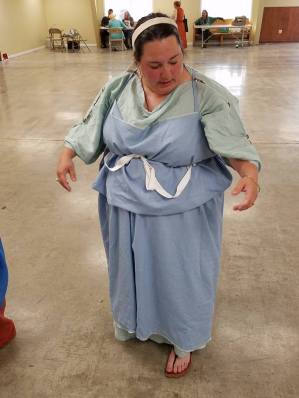
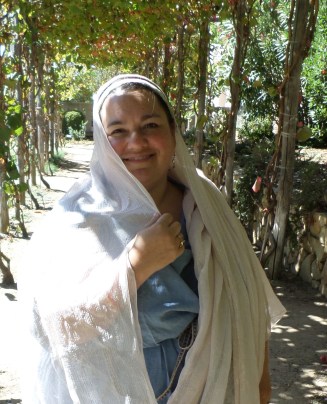
The stola had four major identifying features:
- Worn as an overdress
- Made of lightweight wool
- Constructed as a simple tube, with straps, round pins, or fabric knots at the shoulders, that created a “V neck” with draping.
- Worn double belted, to create an extra folded layer at the hips
The stola was popular for about 400 years (mid-Republic to early Empire), and was integral to the Roman matron’s sense of self. It gave its wearer special social and legal protections.
Note: Click here for PART I: Why Wool?, , PART III: Construction, and PART IV: Timing.
PART II: Color and Embellishments
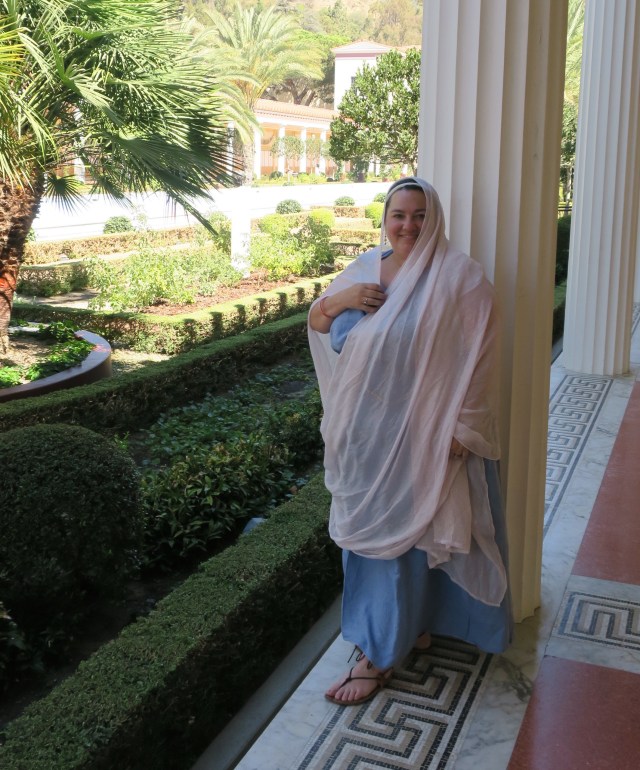
The ancient Romans loved color! They painted their walls, their ceilings, their furniture, and their flags. Their floors were gorgeous (even garish) mosaics. They adored colored gemstones, and used rouge, eyeshadow, and lipstick. Dyes for clothing were used whenever they could be afforded. That said, the ancient world looked different from a modern mall.



 My two pre-written entries were on Roman jewelry and the Roman stola (papers will be posted within a week – I like to incorporate what I learn from the judging process). With the first one, I was focussing on “assembly” type pieces, that I could make in my living room without a studio or fancy equipment, but would still duplicate the aesthetic of Rome from 100 BCE-300 CE. On the left is a largesse box – basically a kit to help others get into basic jewelry making and create period ornaments. One was donated to Dragon’s Mist. Four more will be delivered to Queen Stjarna this weekend.





 ROMANA SUM